


Tang Heritage
Su Embroidery Framed Wall Painting Art | Peonies of Sovereign Beauty
Su Embroidery Framed Wall Painting Art | Peonies of Sovereign Beauty
Couldn't load pickup availability
The peony has been called 国色天香 — sovereign in beauty, incomparable in fragrance. In classical Chinese literary tradition, no flower carries more weight. It was the flower of imperial gardens, of Tang dynasty poets, of the highest social occasions. To embroider it in silk is not simply to depict a flower. It is to enter a lineage of meaning that has accumulated for over a thousand years.
The Embroidery
This piece is worked in the tradition of Su Xiu (苏绣), Suzhou silk embroidery, using 6–8 ply pure mulberry silk thread, hand-stitched stitch by stitch by the artisan. The thread weight used here is slightly fuller than the finest 4-ply work, allowing the artisan to build density and richness in the petals — the depth of colour in a fully opened peony requires a different quality of thread to render convincingly. The result is a surface that holds both volume and luminosity simultaneously.
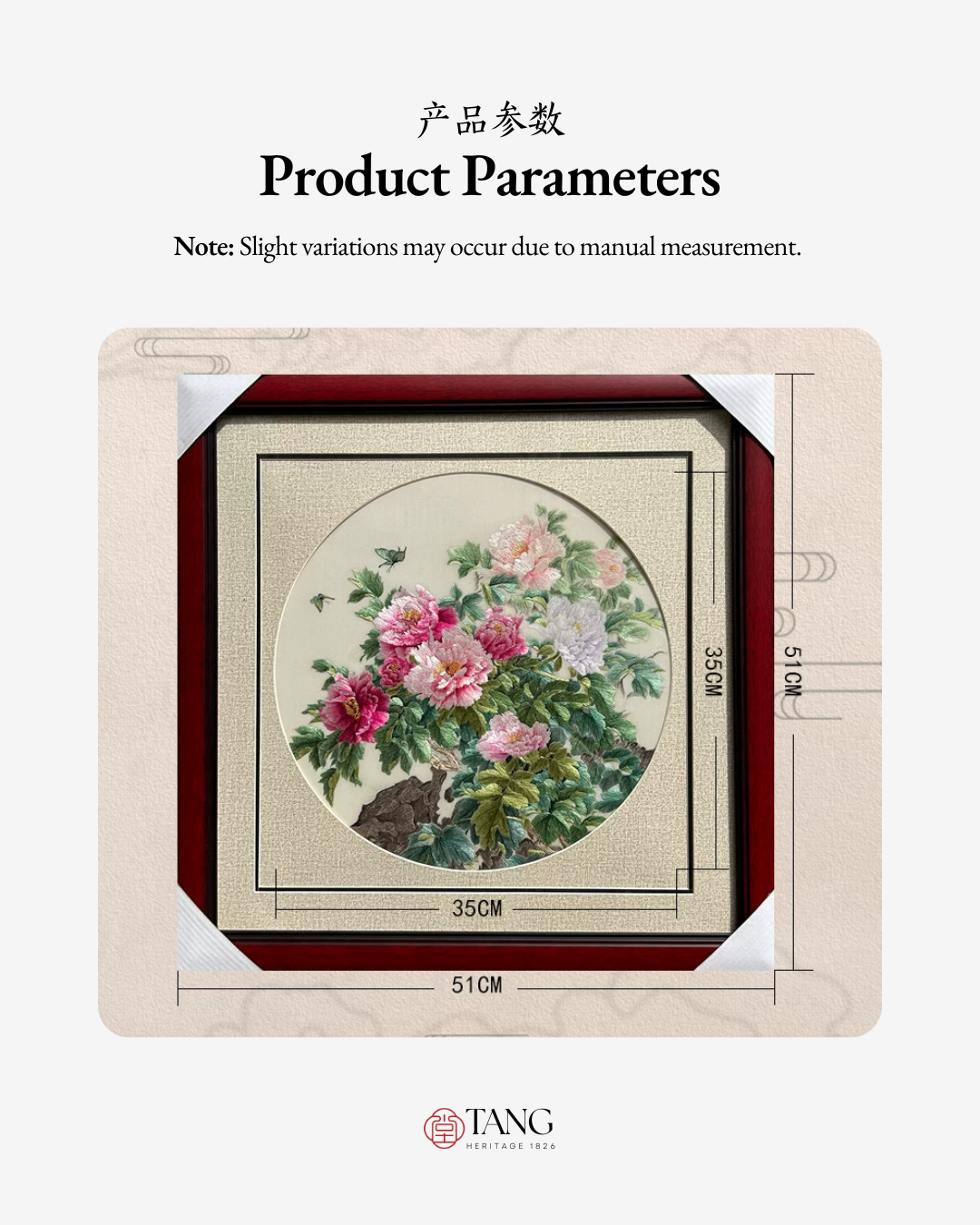
The composition fills the circular field completely: deep pink peonies at their fullest, pale pink blooms opening at the edges, white flowers at rest behind the foreground, lush green foliage layered throughout, and two small butterflies suspended in flight above the garden rock below. Nothing in this piece is incidental. Every element has its place in the classical flower-and-bird composition that Su Xiu has refined over centuries.
Set within a circular silk mount, then framed in a square solid wood frame with an octagonal profile and deep rosewood finish, the piece carries the formal authority of a museum-quality work. The frame does not compete with the embroidery. It frames it as it deserves to be framed.
The Motif
In Chinese art and literary culture, the peony (牡丹, mǔdān) occupies a position held by no other flower. The classical phrase 国色天香 — "sovereign beauty, heavenly fragrance" — was coined specifically for it during the Tang dynasty and has remained its defining description ever since. It is the flower of wealth and honour, of flourishing and abundance, of noble character expressed through natural form.
In decorative art, peonies in full bloom are an auspicious subject, traditionally hung in reception rooms, studies, and spaces where guests are received. They signal not luxury for its own sake, but a cultivated appreciation for what is beautiful and what endures.
The butterflies in the composition carry their own meaning: in Chinese symbolism, butterflies represent joy and the arrival of good fortune. Their presence above the garden rock grounds the composition in the classical natural imagery of the scholar's garden — stone, flower, and the living world in motion above it.
What This Piece Is Really For
This is a piece that holds a room. The richness of the peony composition, the depth of the framing, the circular field within the square; together they create something that reads with authority from across a room and rewards close inspection when approached. It works in a contemporary interior as confidently as in a classical one.
Guests will stop in front of it. They will ask what it is and how it was made. What you tell them — about the craft, the artisan, the tradition behind the motif — is a story that belongs to the piece. Tang Heritage exists so that story is not lost.
Materials
- Embroidery — Pure mulberry silk thread, 6–8 ply, hand-stitched in the Su Xiu (苏绣) tradition on a silk ground fabric
- Frame — Solid wood, deep rosewood finish, square outer profile with octagonal corners
- Mount — Circular embroidery set within a textured linen-toned inner mat
- Glass — High-transparency glass panel protecting the embroidered silk
- Origin — Hand-embroidered in Suzhou, China
Product Details
- Craft — Hand-embroidered Su Xiu (苏绣), 牡丹花 peony motif
- Thread — Pure mulberry silk, 6–8 ply
- Frame material — Solid wood, deep rosewood finish, octagonal profile
- Panel cover — High-transparency glass
- Embroidery core — 35 × 35 cm (circular)
- Framed dimensions — 51 × 51 cm
- Origin — Suzhou, China
- Packaging — Specialist embroidery wooden crate
- Each piece is unique — natural variation inherent to handcraft
- Suitable for home display, gifting, and cultural collection
A Note on Handcraft
Every piece in this collection is embroidered entirely by hand. Silk threads are selected, colour-matched, and placed stitch by stitch by the artisan, not a machine, not a template. As a result, each finished piece carries its own natural character: subtle variations in colour tone, stitch placement, and compositional detail are inherent to the process.
The piece you receive may differ slightly from the product images shown. All product photography is taken from actual pieces under professional lighting; colours may appear slightly different depending on screen settings and ambient light. The actual piece is the reference. This is not a flaw. It is the nature of genuine handcraft, and the mark that makes each piece genuinely its own.
Share


Heritage Refund Policy: 30 Days of Confidence
At Tang Heritage, we stand by the quality and craftsmanship of our products with our Heritage Refund Policy. If there’s any issue with your order, you can contact us at cs@tangheritage.com within 30 days of receiving it, and we’ll make it right — no questions asked.
This iron-clad quality assurance guarantee has been part of our commitment to excellence since the very beginning, ensuring your peace of mind with every purchase. It’s also the reason our customers trust us and keep coming back year after year.
Experience the artistry of Tang Heritage risk-free, knowing that your satisfaction is always our top priority.