TANG GOLD VERMEIL FILIGREE JEWELLERY

Ancient Chinese Goldsmithing Technique,

Recognised by UNESCO,

Worn for the First Time as Quiet Luxury.

A UNESCO-recognised craft. A 2,500-year tradition. 76 steps. All in one collection.

花丝镶嵌 · 金工银作 · 非遗传承

Skip to product information
1 of 14

Tang Heritage

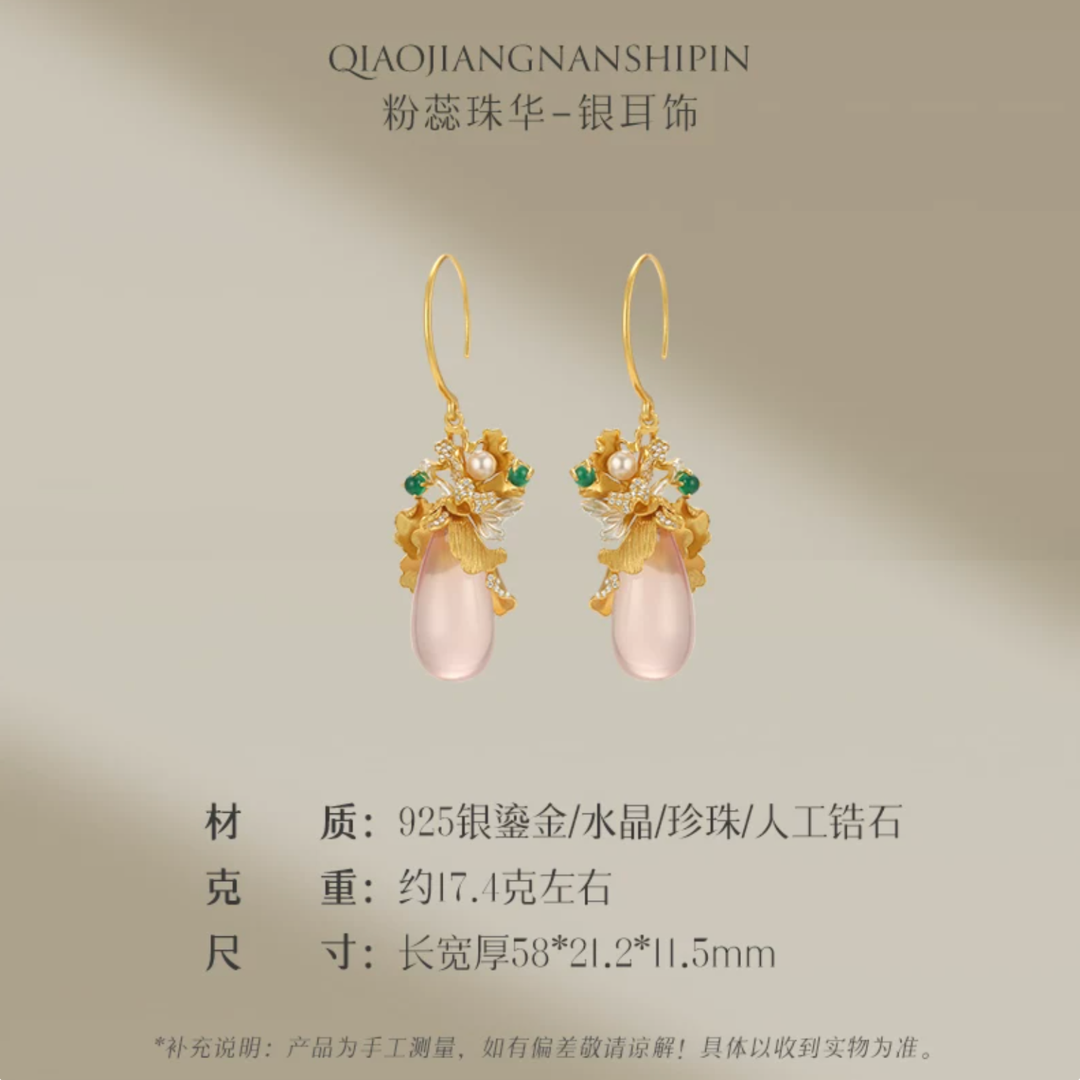
Gold Vermeil Peony Rose Quartz Drop Earrings

Gold Vermeil Peony Rose Quartz Drop Earrings

Regular price $520.80 USD
Regular price Sale price $520.80 USD
Sale Sold out
Shipping calculated at checkout.
EMPTY DOM REMOVE PROTECTOR

旧时王谢堂前燕,飞入寻常百姓家
Swallows that once nested beneath the eaves of noble halls now fly freely into the homes of ordinary families.

A pair of drop earrings rendered in the form of a blooming peony, its petals cast in gold vermeil filigree and brushed with a soft matte finish that catches the light unevenly, as hand worked metal does. Beneath each flower hangs a teardrop of rose quartz, pale and luminous, suspended like a single drop of dew gathered at the close of spring. A freshwater pearl rests at the heart of the blossom, joined by cabochons of deep jade green and a scatter of brilliant pavé stones that trace the curve of each petal.

Cultural Motif and Significance

The peony has long held court as the unofficial sovereign of Chinese flowers, prized for centuries in imperial gardens and court paintings as a symbol of honour, prosperity and feminine grace. To wear a peony is to carry a small portion of that history, a flower once reserved for palace courtyards now rendered in miniature and set close to the skin.

Here the blossom is given a contemporary lightness. The petals curl outward in soft, asymmetrical folds, while the rose quartz drop introduces a note of quiet romance, a stone long associated with tenderness and that is said to soften and warm with wear. Together, the peony and the quartz speak less of grandeur and more of an intimate, personal kind of beauty, the kind worn for oneself rather than for an audience.

Material

  • Solid S925 sterling silver foundation
  • Premium thick gold vermeil exterior, exceeding standard plating depth for deeper colour and extended wear
  • Natural rose quartz teardrop cabochons
  • Freshwater pearl accents
  • Jade green cabochon and clear pavé cubic zirconia detailing
  • 92.5% purity and above
  • Certified free from lead, cadmium, nickel, chromium, and all harmful metals

76 Step Craftsmanship

Each petal of the peony begins as a flat sheet of silver, cut and hammered by hand into the curling, layered form of the blossom before being fired with a premium gold vermeil exterior, exceeding standard plating depth for a richer colour that resists wear over years of use. The construction passes through a sequence of seventy six individual steps, from the initial sketching of the petal outlines through repeated annealing, filing, polishing and stone setting, each stage completed by a single artisan's hand before the piece moves to the next station. Such a process cannot be rushed or mechanised in full, which is why no two pieces emerge quite identical, each carrying the faint, individual traces of the hands that shaped it.

Product Details

  • Material: S925 sterling silver, gold vermeil exterior
  • Gemstones: rose quartz, freshwater pearl, jade green cabochon, cubic zirconia
  • Weight: approximately 17.4g (pair)
  • Dimensions: approximately 58 x 21.2 x 11.5mm
  • Closure: gold vermeil ear hook

For those drawn to quiet, painterly details, an earring that carries the weight of a centuries old motif while sitting as lightly as a single petal against the skin. A piece suited to someone who appreciates the slow labour behind handcraft, and who finds in the rose quartz drop a small daily reminder of warmth and softness amid the pace of modern life.

EMPTY DOM REMOVE PROTECTOR
View full details

THE CRAFT

A UNESCO-Recognised Craft

There is a category of making so rare, so demanding, and so irreplaceable that governments step in to protect it from disappearing. Chinese filigree silversmithing is one of them.

The technique, known in Chinese as 花丝 (huā sī), literally "flower threads", involves drawing silver into wire finer than a human hair, then twisting, stacking, pressing, and soldering it into three-dimensional form, wire by wire, step by step, without machinery and without shortcuts. It has been practised in China for over 2,500 years. It is now formally recognised by UNESCO as intangible cultural heritage: a living tradition so fragile that active intervention is required to preserve it.

The Tang Gold Vermeil Jewellery Collection is built on this technique. Every piece is the work of a lineage of intangible cultural heritage master artisans. Every piece takes 76 steps to complete. This is what that looks like, worn.

text-block-image-template--22352217669890__ss_text_block_pro_NAGarE

WHY IT MATTERS

When UNESCO steps in to protect a craft, you know what you are holding is irreplaceable.

UNESCO does not act unless something is genuinely at risk. The designation of Chinese filigree silversmithing as intangible cultural heritage is not a celebration. It is a recognition that the number of people who truly can do this, at the level of a master artisan, is dwindling.

The knowledge required to draw silver wire to the correct tension, to press and stack it into patterns that hold their three-dimensional form under a lifetime of wear, is not something that can be acquired from a manual or learned in a weekend. It passes from master to student across decades. It lives in the hands before it lives anywhere else.

76

Steps of Ancient Goldsmithing Tradition

2,500 years of ancient Chinese goldsmithing. A 76-step process. The silver drawn into wire, twisted, pressed, stacked, wound, soldered, and set: each stage individually inspected before the next may begin. The 76 steps are the inherited choreography of a 2,500-year-old tradition.

Mass production ends at step one.
Tang Heritage begins at step 76.

2,050

Years of Ancient Chinese Goldsmithing

1

Steps to Complete Each Piece

S

249

Silver Purity Standard

1

UNESCO ICH Elements Held by China