TANG GOLD VERMEIL FILIGREE JEWELLERY

Ancient Chinese Goldsmithing Technique,

Recognised by UNESCO,

Worn for the First Time as Quiet Luxury.

A UNESCO-recognised craft. A 2,500-year tradition. 76 steps. All in one collection.

花丝镶嵌 · 金工银作 · 非遗传承

Skip to product information
1 of 13

Tang Heritage

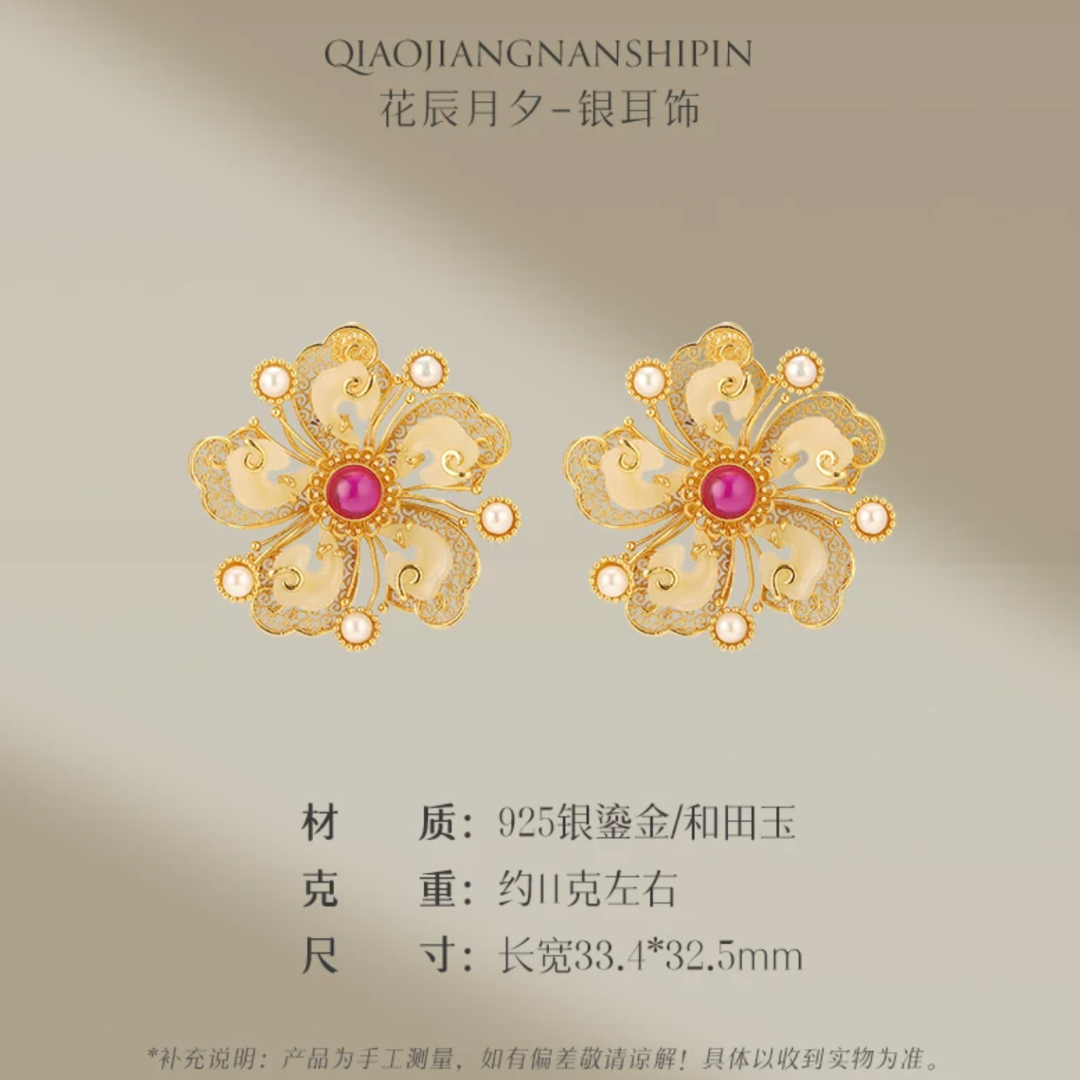
Gold Vermeil Peony Jade Ruby Earrings

Gold Vermeil Peony Jade Ruby Earrings

Regular price $334.40 USD
Regular price Sale price $334.40 USD
Sale Sold out
Shipping calculated at checkout.
EMPTY DOM REMOVE PROTECTOR

旧时王谢堂前燕,飞入寻常百姓家
Swallows that once nested beneath the eaves of noble halls now fly freely into the homes of ordinary families.

A pair of large stud earrings modelled on a peony in full bloom, its petals carved from pale Hetian jade in soft, curling forms. Between the petals, gold vermeil filigree fills the spaces with fine scrolling cloud patterns, the lines unfurling outward like a ruyi motif. At the centre of each flower sits a ruby toned cabochon, with a ring of small pearls scattered along the petal tips, catching the light at the flower's edge.

Cultural Motif and Significance

The peony has long been called the king of flowers in Chinese tradition, its full, layered bloom read as an emblem of wealth, honour, and flourishing fortune. To wear it in full bloom, rather than as a bud or a single petal, is to carry that meaning at its most complete, a wish for abundance rendered in its most generous form.

The scrolling patterns that fill the spaces between the jade petals draw on the ruyi motif, its name carrying the literal meaning of "as you wish," while the ring of pearls at the petal tips adds a further layer of purity and completeness. Together, the jade, the ruby toned centre, and the scattered pearls bring several auspicious traditions into a single flower, each rendered in its own material and craft.

Material

  • Solid S925 sterling silver foundation
  • Premium thick gold vermeil exterior, exceeding standard plating depth for deeper colour and extended wear
  • Natural Hetian jade petals
  • Ruby toned cabochon centre
  • Freshwater pearl accents
  • 92.5% purity and above
  • Certified free from lead, cadmium, nickel, chromium, and all harmful metals

76 Step Craftsmanship

Each petal is carved separately from Hetian jade before being set into a gold vermeil base, with fine filigree threads coiled and soldered into the scrolling patterns that fill the spaces between them. The piece then moves through a sequence of seventy six individual steps, from the initial filigree work through repeated annealing, polishing and stone setting, with the ruby toned centre and surrounding pearls fitted only once the jade petals and filigree are fully assembled. Such intricate handwork resists full mechanisation, which is why no two pieces emerge quite identical, each carrying the faint, individual traces of the hands that shaped it.

Product Details

  • Material: S925 sterling silver, gold vermeil exterior
  • Motif: peony in full bloom with ruyi cloud filigree
  • Gemstones: Hetian jade, ruby toned cabochon, freshwater pearl
  • Weight: approximately 11g (pair)
  • Dimensions: approximately 33.4 x 32.5mm
  • Closure: post fastening

For those drawn to pieces with real presence, an earring that brings together carved jade, fine filigree, and scattered pearls in the generous form of a flower in full bloom. A piece suited to someone who wants their jewellery to feel abundant and complete, carrying an old wish for flourishing fortune in every petal.

EMPTY DOM REMOVE PROTECTOR
View full details

THE CRAFT

A UNESCO-Recognised Craft

There is a category of making so rare, so demanding, and so irreplaceable that governments step in to protect it from disappearing. Chinese filigree silversmithing is one of them.

The technique, known in Chinese as 花丝 (huā sī), literally "flower threads", involves drawing silver into wire finer than a human hair, then twisting, stacking, pressing, and soldering it into three-dimensional form, wire by wire, step by step, without machinery and without shortcuts. It has been practised in China for over 2,500 years. It is now formally recognised by UNESCO as intangible cultural heritage: a living tradition so fragile that active intervention is required to preserve it.

The Tang Gold Vermeil Jewellery Collection is built on this technique. Every piece is the work of a lineage of intangible cultural heritage master artisans. Every piece takes 76 steps to complete. This is what that looks like, worn.

text-block-image-template--22352217669890__ss_text_block_pro_NAGarE

WHY IT MATTERS

When UNESCO steps in to protect a craft, you know what you are holding is irreplaceable.

UNESCO does not act unless something is genuinely at risk. The designation of Chinese filigree silversmithing as intangible cultural heritage is not a celebration. It is a recognition that the number of people who truly can do this, at the level of a master artisan, is dwindling.

The knowledge required to draw silver wire to the correct tension, to press and stack it into patterns that hold their three-dimensional form under a lifetime of wear, is not something that can be acquired from a manual or learned in a weekend. It passes from master to student across decades. It lives in the hands before it lives anywhere else.

76

Steps of Ancient Goldsmithing Tradition

2,500 years of ancient Chinese goldsmithing. A 76-step process. The silver drawn into wire, twisted, pressed, stacked, wound, soldered, and set: each stage individually inspected before the next may begin. The 76 steps are the inherited choreography of a 2,500-year-old tradition.

Mass production ends at step one.
Tang Heritage begins at step 76.

2,050

Years of Ancient Chinese Goldsmithing

1

Steps to Complete Each Piece

S

249

Silver Purity Standard

1

UNESCO ICH Elements Held by China