TANG GOLD VERMEIL FILIGREE JEWELLERY

Ancient Chinese Goldsmithing Technique,

Recognised by UNESCO,

Worn for the First Time as Quiet Luxury.

A UNESCO-recognised craft. A 2,500-year tradition. 76 steps. All in one collection.

花丝镶嵌 · 金工银作 · 非遗传承

Skip to product information
1 of 13

Tang Heritage

Gold Vermeil Dielianha Butterfly Ring

Gold Vermeil Dielianha Butterfly Ring

Regular price $344.80 USD
Regular price Sale price $344.80 USD
Sale Sold out
Shipping calculated at checkout.
EMPTY DOM REMOVE PROTECTOR
Colour
EMPTY DOM REMOVE PROTECTOR

蝶恋花,金丝绕芳华

The butterfly alights on the flower: a moment of perfect beauty, held still in gold.

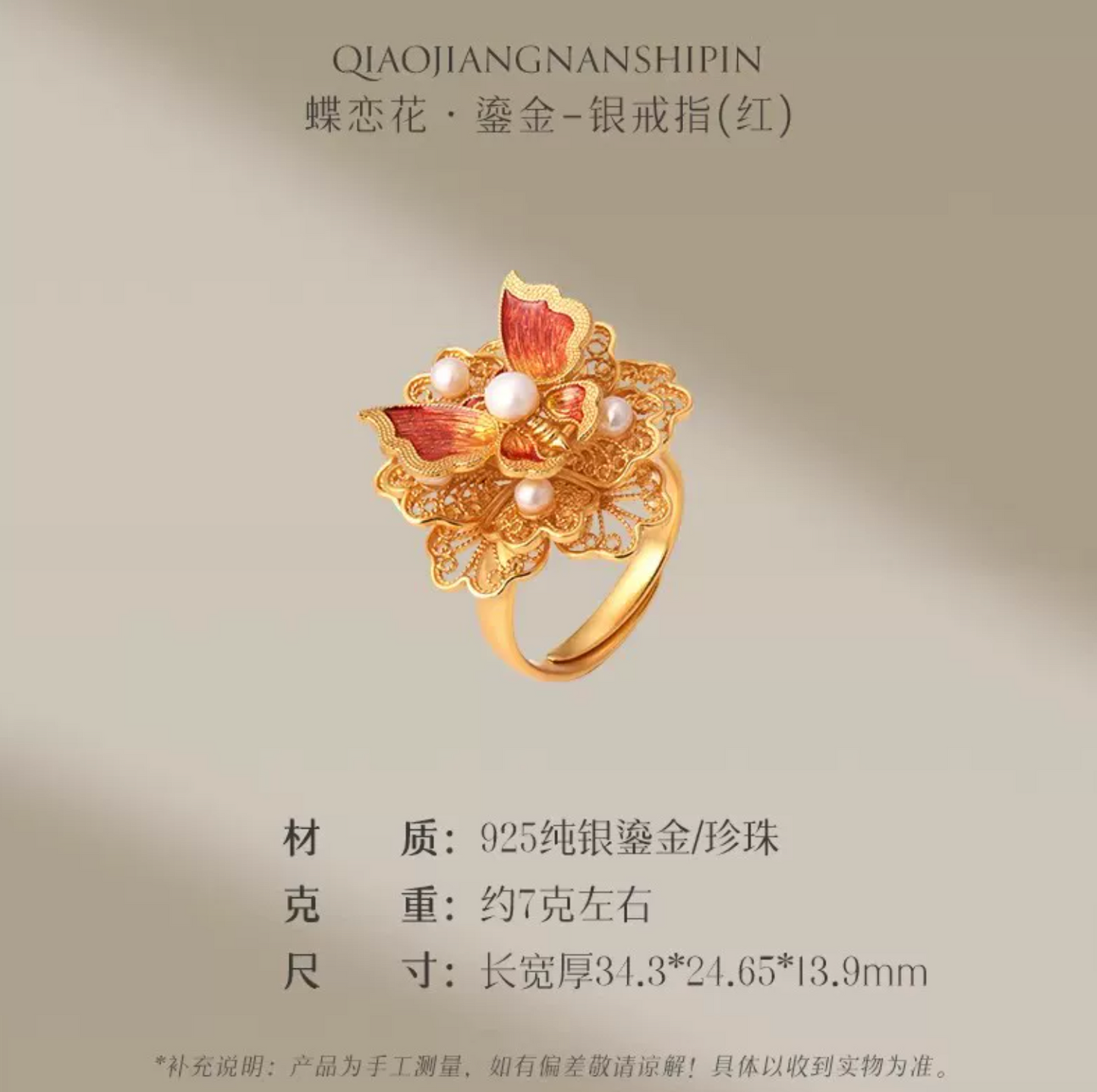
The Gold Vermeil Dielianha Butterfly Ring is a statement piece built at the intersection of two of the most enduring motifs in Chinese decorative art. A large filigree flower in hand-wrought goldwork forms the base of the composition, its petals layered and detailed in the open lattice work of intangible cultural heritage silversmithing. Across the centre of the flower, a butterfly alights with wings spread wide, each wing rendered in kiln-fired high-temperature enamel: vivid, permanent, and exactly the colour of something alive. Five freshwater pearls are set across the flower and butterfly body, their lustre a quiet counterpoint to the warmth of the gold. The ring is a complete picture — flower, butterfly, pearl — assembled from materials and techniques that have been refined across centuries, worn on a single finger as though it weighs nothing at all.

Cultural Motif & Significance

蝶恋花 (dié liàn huā) — the butterfly loves the flower — is one of the oldest and most beloved images in Chinese poetry and decorative art. It originates as a ci poetry form from the Song dynasty, its name borrowed from the image of a butterfly drawn irresistibly to a flower in bloom: a metaphor for longing, for the beauty that compels without demanding, for the kind of devotion that is entirely voluntary. In Chinese visual culture, the butterfly carries meanings of joy, transformation, and the lightness of a life lived well. The flower — particularly the peony and the lotus — speaks of abundance, of the full expression of beauty at its peak.

Together, they form a composition that has appeared across embroidery, lacquerware, porcelain, and court jewellery for over a thousand years. To wear this ring is to wear that image in its most concentrated form: the butterfly on the flower, in gold, at the finger.

Material

  • Solid S999 sterling silver foundation
  • Premium thick gold vermeil exterior, exceeding standard plating depth for deeper colour and extended wear
  • Silver sourced from premium-grade ore at 99% purity and above, the standard of aerospace and precision engineering
  • Kiln-fired high-temperature enamel butterfly wings, fired for permanence of colour
  • Five freshwater pearl accents, individually selected for lustre and roundness
  • Certified free from lead, cadmium, nickel, chromium, and all harmful metals

76-Step Craftsmanship

Every ring is completed across 76 exacting steps of ancient goldsmithing tradition: the silver drawn into wire, twisted, pressed, stacked, wound, soldered, and set, with each stage individually inspected before the next may begin. This is the practice of intangible cultural heritage silversmithing, carried forward by a lineage of master artisans for whom patience and precision are not virtues but necessities. The resulting texture is crisp, architectural, and three-dimensional in a way that lies entirely beyond the reach of mechanical production. It is craft preserved not as performance, but as standard.

Product Details

  • Material: Solid S999 sterling silver with premium thick gold vermeil, kiln-fired high-temperature enamel, and freshwater pearl accents
  • Net weight: Approximately 7g, hand-measured
  • Dimensions: Length 34.3mm × width 24.65mm × thickness 13.9mm
  • Available colours: Gold Vermeil with Teal Enamel, Gold Vermeil with Red Enamel
  • All measurements are hand-taken and may carry minor tolerances.

For the woman who understands that a ring can be a world unto itself. For the occasion that calls for something that stops a room without trying. For the gift that carries one of the oldest love poems in the Chinese tradition, worn at the finger in gold and enamel and pearl. The Gold Vermeil Dielianha Butterfly Ring is presented in Tang Heritage's signature gift box, ready to be worn and admired.

EMPTY DOM REMOVE PROTECTOR
View full details

THE CRAFT

A UNESCO-Recognised Craft

There is a category of making so rare, so demanding, and so irreplaceable that governments step in to protect it from disappearing. Chinese filigree silversmithing is one of them.

The technique, known in Chinese as 花丝 (huā sī), literally "flower threads", involves drawing silver into wire finer than a human hair, then twisting, stacking, pressing, and soldering it into three-dimensional form, wire by wire, step by step, without machinery and without shortcuts. It has been practised in China for over 2,500 years. It is now formally recognised by UNESCO as intangible cultural heritage: a living tradition so fragile that active intervention is required to preserve it.

The Tang Gold Vermeil Jewellery Collection is built on this technique. Every piece is the work of a lineage of intangible cultural heritage master artisans. Every piece takes 76 steps to complete. This is what that looks like, worn.

text-block-image-template--22352217669890__ss_text_block_pro_NAGarE

WHY IT MATTERS

When UNESCO steps in to protect a craft, you know what you are holding is irreplaceable.

UNESCO does not act unless something is genuinely at risk. The designation of Chinese filigree silversmithing as intangible cultural heritage is not a celebration. It is a recognition that the number of people who truly can do this, at the level of a master artisan, is dwindling.

The knowledge required to draw silver wire to the correct tension, to press and stack it into patterns that hold their three-dimensional form under a lifetime of wear, is not something that can be acquired from a manual or learned in a weekend. It passes from master to student across decades. It lives in the hands before it lives anywhere else.

76

Steps of Ancient Goldsmithing Tradition

2,500 years of ancient Chinese goldsmithing. A 76-step process. The silver drawn into wire, twisted, pressed, stacked, wound, soldered, and set: each stage individually inspected before the next may begin. The 76 steps are the inherited choreography of a 2,500-year-old tradition.

Mass production ends at step one.
Tang Heritage begins at step 76.

2,050

Years of Ancient Chinese Goldsmithing

1

Steps to Complete Each Piece

S

249

Silver Purity Standard

1

UNESCO ICH Elements Held by China